To enhance indoor air quality in 2025, consider systems like positive pressure attack ventilation systems, tire pressure monitoring systems, and advanced pressure cookers for canning. Utilize fluid extractors and digital air pressure meters for HVAC needs, and make certain you’re equipped with reliable manometers. It’s crucial to prioritize compatibility, efficiency ratings, and maintenance needs when choosing a system. Keeping these factors in mind will guide your selection process for peak air quality. There’s even more to explore!
Positive Pressure Attack for Ventilation & Firefighting

If you’re a firefighter looking to enhance your ventilation tactics, Positive Pressure Attack (PPA) is a game changer. This innovative approach boosts your effectiveness during structural fires, improving victim survivability. The technique’s well-researched concepts make it accessible for all levels, from rookies to chiefs. You’ll be amazed at how quickly PPA can change the dynamics in house fires. While some departments might face manpower challenges, adopting PPA prioritizes public safety and expedites fire attacks. If you haven’t yet explored this technique, consider diving into the available literature to equip yourself with essential knowledge and tactics for successful firefighting.
Best For: Firefighters at all levels seeking to improve their ventilation tactics and fire attack strategies.
Pros:
- Enhances victim survivability during structural fires through effective ventilation techniques.
- Accessible educational resource for both firefighters and engineers, written in layman’s terms.
- Encourages quicker fire attacks and prioritizes public safety, making it a practical tool for departments.
Cons:
- Some departments may struggle with manpower limitations when implementing PPA techniques.
- There is a perceived bias towards a specific fan manufacturer, potentially affecting objectivity.
- Lack of an ebook version may hinder accessibility for those who prefer digital formats.
Tire Pressure Monitoring System with 4 Sensors and LCD Display
Product not found or API error.
The Tire Pressure Monitoring System (TPMS) with 4 sensors and an LCD display is an ideal choice for drivers seeking enhanced safety and real-time monitoring of tire conditions. This system features wireless solar power and USB charging, ensuring continuous operation. The colorful LCD provides immediate alerts for pressure and temperature anomalies, enhancing your safety on the road. With high-precision sensors, you’ll receive accurate data with minimal error. Customers appreciate its easy installation and effective monitoring, while the 365-day guarantee adds peace of mind. Just keep an eye on sensor syncing and brightness for peak performance.
Best For: Drivers looking for a reliable and user-friendly tire pressure monitoring solution to enhance safety and prevent tire-related incidents.
Pros:
- High-precision sensors provide accurate real-time monitoring of tire pressure and temperature.
- Solar power and USB charging ensure continuous operation regardless of weather conditions.
- Easy installation and a 365-day guarantee offer peace of mind for customers.
Cons:
- Some users report issues with sensor syncing that may affect performance.
- Visibility of the LCD display may be reduced in bright sunlight.
- Feedback suggests improvements are needed for sensor backing quality.
All American 21.5qt Pressure Cooker/Canner (The 921)
Product not found or API error.
For home canning enthusiasts seeking a reliable and efficient solution, the All American 21.5qt Pressure Cooker/Canner (Model 921) stands out with its impressive capacity to hold approximately 19 pint jars or 7 quart jars. Made in the USA, this sturdy canner features a metal-to-metal seal for a steam-tight fit, ensuring safe canning of meats, vegetables, and fruits. Users rave about its performance, processing over 200 quarts annually with minimal propane usage. With an easy-to-read steam gauge and durable construction, it’s a solid investment for anyone serious about canning. Just be sure to watch instructional videos for best practices!
Best For: Home canning enthusiasts looking for a reliable and efficient pressure cooker/canner for processing large quantities of food.
Pros:
- Durable construction with a metal-to-metal seal for safe and effective canning.
- High capacity allows for processing approximately 19 pint jars or 7 quart jars at once.
- User-friendly features, including an easy-to-read steam gauge and precision pressure control.
Cons:
- Large size may require additional kitchen space or outdoor use.
- New users might face a learning curve and need to familiarize themselves with operational instructions.
- Heavy weight (24.7 pounds) can make it less portable and more cumbersome to handle.
Mityvac MV7102 Fluid Extractor Dispenser
Product not found or API error.
Engineers and mechanics seeking a reliable tool for fluid management will find the Mityvac MV7102 Fluid Extractor Dispenser an invaluable addition to their toolkit. With a 2.5-quart capacity and 120 PSI operation, it efficiently evacuates, tops off, and refills fluids in various vehicles. Its isolated flow control and pneumatic kit make switching between extraction and dispensing effortless. You’ll appreciate the safety features, including overflow protection and a venturi vacuum lid. Rated 4.5 stars by satisfied customers, it’s well-regarded for its quality and functionality. Backed by a one-year warranty, Mityvac continues to be a trusted name in automotive tools.
Best For: Engineers and mechanics seeking an efficient and reliable tool for fluid management in various vehicles.
Pros:
- Versatile functionality allows for evacuating, topping-off, and refilling multiple types of fluids including brake, power steering, and engine oil.
- User-friendly design with isolated flow control and easy switching between extraction and dispensing.
- Safety features such as overflow protection and a venturi vacuum lid enhance operational security.
Cons:
- Not compatible with solvents, liquid fuels, and DEF, limiting its use with certain fluids.
- Some users report concerns about performance and customer support, indicating potential reliability issues.
- Limited capacity at 2.5 quarts may not be sufficient for larger jobs or heavy-duty applications.
Digital Air Pressure Meter for HVAC and Gas Pressure Testing

When precision matters, the Digital Air Pressure Meter stands out as an essential tool for HVAC professionals and technicians involved in gas pressure testing. This dual-port manometer measures air and non-corrosive gas pressures with remarkable accuracy of ±0.3% FS. It’s perfect for various applications, from natural gas pipelines to refrigeration systems. You’ll appreciate the fast response time of 0.1 seconds and the ability to switch between 11 measurement units. With data storage for 99 measurements and a large HD LCD display, you can easily manage and view your results, even in low light. Reliable and efficient, it’s a must-have for your toolkit.
Best For: HVAC professionals and technicians who require precise measurements of air and non-corrosive gas pressures in various applications.
Pros:
- High accuracy of ±0.3% FS ensures reliable measurements.
- Fast response time of 0.1 seconds allows for efficient testing.
- Supports 11 measurement units, enhancing versatility in different settings.
Cons:
- Limited to non-corrosive gases, which restricts its use in certain environments.
- Data storage for only 99 measurements may not suffice for extensive projects.
- Automatic power-off feature might interrupt usage if not monitored closely.
Manometer, Dual-Port HVAC Gas Pressure Tester (PT503)

The PT503 Dual-Port HVAC Gas Pressure Tester stands out as an essential tool for HVAC technicians and professionals who prioritize accuracy in measuring gas pressure. With a measurement range of -100 to 200 kPa and ±0.5%FS accuracy, this compact manometer offers versatility with six unit options. Its fast-response sensor and clear LCD display guarantee easy readability, even for those with corrective lenses. Lightweight and portable, it includes seven adapters for various applications, making it ideal for on-site use. While some users reported latency issues, it remains a solid choice for basic measurements, providing great value for occasional use.
Best For: HVAC technicians and professionals seeking an accurate and portable solution for measuring gas pressure.
Pros:
- Compact and lightweight design, ideal for on-site use and emergency servicing.
- Fast-response sensor with a clear LCD display for easy readability.
- Includes seven adapters for versatile applications across different systems.
Cons:
- Some users report latency issues and lack of repeatability in readings.
- No continuous monitoring capability due to self-zeroing feature upon power cycling.
- Display style may feel outdated to some users, affecting overall aesthetics.
B-Qtech Tire Pressure Monitoring System (TPMS) with 8 Sensors
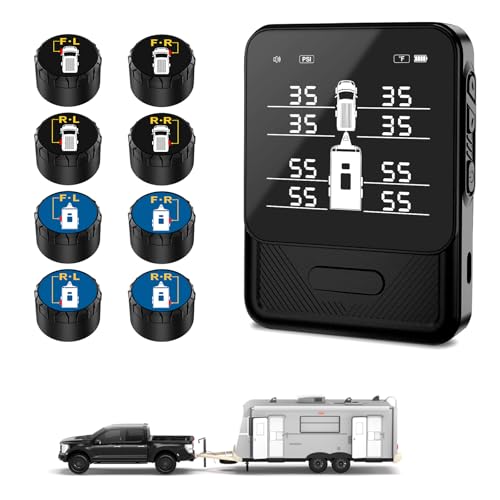
For those who prioritize safety and efficiency on the road, the B-Qtech Tire Pressure Monitoring System (TPMS) with 8 sensors is an ideal choice. It offers real-time monitoring of tire pressure and temperature, ensuring you stay informed. With a 3.15-inch high-resolution LCD display, you can easily see critical data. The system provides alerts for pressure changes and temperature surges, helping you avoid blowouts and save on fuel. Installation is a breeze thanks to its magnetic mount design. Plus, its durable, waterproof sensors are designed for long-term use, giving you peace of mind on every journey.
Best For: Drivers of cars, trucks, RVs, trailers, and campers who prioritize safety and real-time tire monitoring on the road.
Pros:
- Real-time alerts for pressure and temperature changes enhance driving safety.
- Easy installation with a magnetic mount design, making setup quick and hassle-free.
- Durable waterproof and dustproof sensors provide long-term reliability.
Cons:
- The best sellers rank may indicate limited popularity or market presence.
- Requires regular charging of the sensors to ensure functionality.
- Custom settings may be complicated for users unfamiliar with TPMS technology.
Factors to Consider When Choosing Positive Pressure Systems
When choosing a positive pressure system, you need to take into account several key factors. System compatibility, performance efficiency, and ease of use should top your list, as they directly impact your experience. Additionally, don’t overlook maintenance requirements and sensor accuracy to guarantee reliable operation over time.
System Compatibility Requirements
Choosing the right positive pressure system requires careful consideration of compatibility with your building’s design and existing systems. First, verify the system meets your building’s specific airflow requirements, especially during firefighting operations. It’s essential that it integrates seamlessly with current ventilation and suppression systems to boost effectiveness and safety. Additionally, check the system’s ability to function under various environmental conditions, such as extreme temperatures and humidity, which can impact performance. Evaluate how well it works with the fans and equipment you plan to use alongside positive pressure ventilation methods. Finally, make certain the selected system complies with local fire codes and regulations, guaranteeing safety during fire incidents while enhancing indoor air quality.
Performance Efficiency Ratings
Understanding performance efficiency ratings is vital for selecting the best positive pressure system for your needs. Factors like airflow rate and pressure differential greatly impact a system’s effectiveness in smoke and heat expulsion. Aim for an ideal pressure differential, typically measured in inches of water column (inH2O), to enhance safety. Systems with higher airflow rates, measured in cubic feet per minute (CFM), clear smoke and toxic gases more quickly, improving victim survivability. Additionally, evaluate how well a system maintains consistent pressure levels during operation, as this is essential for effective ventilation. Finally, consider the system’s responsiveness to changing fire conditions; rapid adjustments can greatly enhance your overall firefighting effectiveness.
User-Friendly Interface Design
A well-designed user interface is essential for the effective operation of positive pressure systems, especially in high-stress situations. You’ll want an interface with intuitive navigation for quick access to essential functions and settings, boosting your operational efficiency. Look for clear labeling and visual cues, like icons and color coding, to improve comprehension and minimize errors. Responsive touchscreens or easily accessible buttons enable swift adjustments without distracting you from critical tasks. Feedback mechanisms, such as audio alerts or visual confirmations, keep you informed about the system’s status and required actions. Finally, a customizable interface lets you prioritize and arrange information to suit your preferences, enhancing usability in various operational scenarios.
Maintenance and Care Needs
Effective user interface design plays a vital role in managing positive pressure systems, but their long-term functionality relies heavily on proper maintenance and care. Regular inspections of seals, fans, and ductwork are essential to spot any signs of wear or damage. Cleaning system components like filters and fans not only enhances airflow efficiency but also prolongs equipment lifespan. You should calibrate pressure sensors and control systems to guarantee accurate readings and effective operation. Always follow the manufacturer’s maintenance guidelines to avoid operational failures and guarantee compliance with safety standards. Finally, document all maintenance activities, including inspections and repairs, to track system performance and identify potential issues early on. This proactive approach keeps your system running smoothly.
Sensor Accuracy and Reliability
When selecting positive pressure systems, sensor accuracy and reliability are critical factors that directly impact performance and safety. Aim for high-precision sensors with an accuracy of ±0.3% to ±0.5% of full scale, ensuring you get dependable data readings. Responsiveness also matters; sensors that react within 0.1 seconds allow for real-time monitoring of pressure changes, which is essential in critical situations. Regular calibration and maintenance are crucial to keep your sensors reliable, as drift can lead to errors over time. Consider dual-port designs for simultaneous monitoring of positive and negative pressures, enhancing reliability. Finally, choose sensors built to withstand environmental factors like temperature and humidity, ensuring consistent performance in varying conditions.
Installation Process Complexity
Sensor accuracy and reliability set the groundwork for effective positive pressure systems, but the installation process brings its own set of challenges. The complexity of installation often hinges on your building’s structure and the system design you choose. You’ll need a solid grasp of airflow dynamics and your layout to guarantee integration doesn’t compromise efficiency. Some systems might even require modifications to existing ventilation, which can up the complexity and demand extra resources. It’s essential to train personnel involved in the setup; improper installation can lead to ineffective pressure maintenance and potential safety hazards during firefighting. Finally, don’t forget local building codes, as they can dictate specific standards for fire safety and ventilation systems that you must adhere to.
Cost and Budget Considerations
Budgeting for Positive Pressure Systems requires careful consideration of both upfront and ongoing costs to guarantee they fit within your financial plans. Start by evaluating the initial purchase price and don’t forget ongoing maintenance expenses, which are essential for long-term affordability. Also, remember that effective systems can reduce operational costs and save money during emergencies, enhancing survivability. Include training costs for personnel, as these systems demand specific techniques for effective use. Evaluate any necessary compatible equipment, like fans and ventilation tools, to ascertain maximum efficiency. Finally, factor in potential additional resources, such as manpower and support equipment, as these could greatly impact your overall budget for implementing Positive Pressure Systems in your operations.