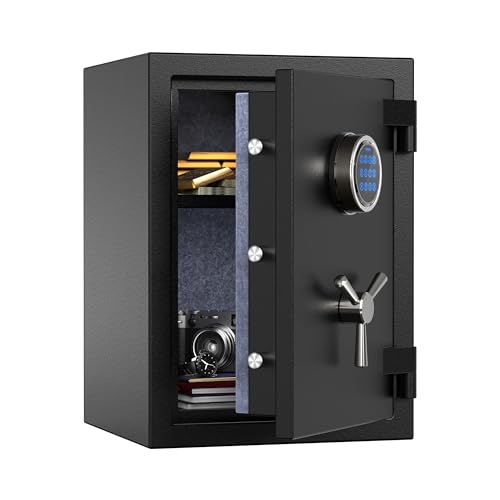
A bank vault’s core structure consists of reinforced concrete, which is fortified with steel rods for added strength. These vaults often feature steel-reinforced modular panels that make them lightweight yet secure. Vault doors are constructed using thick layers of steel and concrete, sometimes combined with copper or aluminum for fire resistance. Advanced locking mechanisms and security enhancements are also integral. Discover how innovations continue to shape vault technology for even greater security.
Key Takeaways
- Bank vaults are primarily constructed from reinforced concrete, providing structural strength and durability.
- Steel rods are embedded within the concrete walls to enhance crushing resistance.
- Modular concrete panels, reinforced with steel, are utilized for lightweight yet secure construction.
- Vault doors consist of thick layers of steel, concrete, and fire-resistant materials like copper or aluminum.
- Advanced locking mechanisms, such as dual-control combination locks, are integrated for enhanced security.
Composition of Vault Materials
When considering the composition of bank vault materials, it’s essential to understand that reinforced concrete forms the backbone of vault construction. This concrete is enhanced with proprietary additives to boost strength and durability against break-in attempts.
Steel rods are embedded within the walls, providing vital crushing resistance and structural integrity. Modern vaults utilize steel-reinforced modular concrete panels, which are engineered for lightweight security while maintaining exceptional strength.
Vault doors typically combine thick steel and concrete, sometimes layered with copper or aluminum for fire resistance. Together, these elements guarantee peak security for valuables stored within the vault.
Historical Development of Bank Vaults
Although the concept of securing valuables has existed since ancient civilizations, the historical development of bank vaults truly began to take shape in the 19th century, driven by the Industrial Revolution.
The 19th century marked a pivotal shift in bank vault security, propelled by the innovations of the Industrial Revolution.
This era introduced innovations that revolutionized security:
- Thick steel plates enhanced structural integrity.
- Basic mechanical locks evolved into advanced combination systems and time locks.
- Banks implemented multilayered defenses, including alarm systems and hidden vault locations.
Design Specifications for Security
To guarantee maximum security, the design specifications for bank vaults are meticulously tailored to meet the unique needs of each financial institution.
Collaborations between bank architects and vault manufacturers refine these requirements, focusing on size, shape, and essential security features.
Modern vaults utilize modular panels made of steel-reinforced concrete, engineered for crush resistance, ensuring robust yet efficient construction.
Vault doors combine steel and concrete with multiple layers for added protection.
Massive metal bolts and advanced locking mechanisms, like dual-control combination locks, enhance security, providing secure storage while deterring unauthorized access.
Each element is custom-tailored for peak performance and reliability.
The Manufacturing Process of Vaults
In the manufacturing process of vaults, you start with molding wall panels from a reinforced concrete mix that includes metal shavings for enhanced drill resistance.
Next, you manually place reinforcing steel rods into the damp mix before vibrating the panels to guarantee a smooth finish and eliminate air pockets.
Finally, after the panels harden, you transport them for assembly, where precision welding forms the secure vault structure.
Panel Molding Techniques
When crafting bank vault panels, manufacturers utilize a specialized reinforced concrete mix that sets rapidly, typically within 6 to 12 hours. This efficient process incorporates several key techniques:
- Metal shavings enhance drill resistance against burglary attempts.
- Reinforcing steel rods are manually placed into the damp concrete, boosting structural integrity.
- Molds are vibrated for hours to eliminate air pockets, ensuring a solid structure.
Once the vault wall panels are molded and dried, they’re transported to the construction site for assembly.
The panels are welded together, forming a secure vault structure that withstands potential threats while maintaining durability and strength.
Reinforcement and Assembly Process
Although the manufacturing process of bank vaults involves intricate procedures, it fundamentally relies on the reinforcement and assembly of modular concrete panels. These panels, crafted from steel-reinforced concrete, maximize strength and crush resistance. Reinforcing steel rods are strategically placed in the damp mix before setting, guaranteeing durability. The assembly process also includes manufacturing robust vault doors using either a concrete-first method or steel molds filled with concrete. Quality control by Underwriters Laboratories, Inc. guarantees compliance with security standards against unauthorized access.
| Aspect | Description |
|---|---|
| Panel Composition | Steel-reinforced concrete panels |
| Reinforcement Method | Manual placement of reinforcing steel |
| Quality Control Standard | Underwriters Laboratories, Inc. |
Quality Control and Resistance Standards
When evaluating the quality control of bank vaults, you’ll encounter Underwriters Laboratories (UL) testing standards, which establish rigorous resistance benchmarks for break-in attempts.
In the U.S., vaults are classified into UL Classes that indicate their ability to withstand forced entry for varying durations.
European standards, specifically Euronorm 1143-1:2012, provide a grading system that evaluates vaults based on their vulnerability to penetration methods.
UL Testing Standards
UL testing standards play an essential role in evaluating the security of bank vaults, as they provide a systematic evaluation of a vault’s resistance to break-in attempts.
Conducted by Underwriters Laboratories, Inc., this testing classifies vaults into three classes based on their burglary resistance:
- Class 1 vaults: Resist entry for 30 minutes.
- Class 2 vaults: Resist entry for 60 minutes.
- Class 3 vaults: Resist entry for 120 minutes.
UL testing employs common tools and cutting torches, focusing solely on burglary resistance.
Manufacturers must also conduct their own testing to validate the security of their vault designs, ensuring compliance with UL standards.
Euronorm Resistance Ratings
Euronorm resistance ratings, specifically outlined in standard Euronorm 1143-1:2012, provide a structured evaluation of vault security against burglary attempts in Europe. These ratings range from 0 to XIII, reflecting the specific level of resistance to various penetration attempts. Financial institutions must consider these Euronorm ratings to meet their security needs effectively.
| Grade | Description |
|---|---|
| 0 | No resistance |
| I | Low resistance |
| VII | High resistance |
| XIII | Very high resistance |
The rigorous testing regime includes methods like core drilling and explosive breaching to guarantee compliance with established safety benchmarks.
Future Trends in Vault Technology
As technology evolves, vault systems are set to undergo transformative changes that prioritize security and efficiency.
Future vaults will integrate advanced biometric systems, artificial intelligence, and modular construction techniques, enhancing functionality.
Key trends include:
- Real-time monitoring and anomaly detection through sophisticated security systems.
- Specialized vaults for digital currency employing advanced encryption techniques.
- Utilization of eco-friendly materials and energy-efficient designs.
These innovations won’t only improve security but also allow for increased customization, ensuring vaults meet specific client needs while minimizing environmental impact.
Embracing these trends will redefine vault technology for a secure future.